 Elevated
 The question isn't whether to use AI for your content. That ship has sailed, and pretending otherwise just means doing more work than the person next to you. The real question is where AI actually helps, and where handing it the wheel quietly costs you the thing that makes people follow you in the first place. Here's the honest line between the two.
What to let AI do
AI is genuinely good at the parts of content work that are repetitive, structural, or just a blank-page problem. These are the tasks worth automating, because speeding them up frees your time for the parts only you can do.
Ideation. Staring at a blank content calendar is the slowest part of the week. AI is excellent at generating a long list of angles to react to. You won't use most of them, but a list of twenty is far easier to sharpen than a blank page. A tool like the free Idea Brainstormer exists for exactly this moment.
Planning and structure. Turning a rough idea into a month of posts balanced across content types is tedious by hand and quick for AI. Let it build the skeleton, then you decide what actually goes out.
Hooks and caption drafts. This is where AI earns its keep for most creators. Feed it your niche and a topic, get ten hook options, and pick the one that sounds like you. If you run a faceless page, this pairs directly with the workflow in our guide on posting faceless content without filming anything, where the hook is doing most of the work anyway.
Repurposing. One good post can become a carousel, a caption, a pin, and a short script. That's mechanical translation, and AI does it in seconds instead of an hour.
First drafts of anything. A rough draft you edit is always faster than a blank document you start. This applies to captions, emails, and even a full digital product. When we walk through creating an ebook in Canva, AI does the heavy lifting on the first draft so you can spend your time on the parts that matter.
What you should still do yourself
Here's the part most "AI will do everything" advice skips. The tasks above are the scaffolding. The things below are the building, and they're exactly what makes someone choose you over the thousand other accounts posting similar stuff.
Your point of view. AI can tell you what everyone already agrees on. It cannot tell you what you actually think, especially when your take cuts against the grain. Your opinion is the reason people follow you instead of a search engine.
Your stories. The specific thing that happened to you, the client who taught you something, the mistake you made at 2 a.m. AI can only average what already exists. Your real experience is the one thing it structurally cannot generate.
Your taste. AI gives you ten options. Knowing which one is good is taste, and taste is the whole job. The creator who can tell the great hook from the fine one wins, and that judgment is yours.
The final edit. The pass where you cut the hedging, add the line only you would write, and make it sound like a person. This is the step that removes the AI tell, and it takes minutes but changes everything.
The final call. Whether it's good enough to publish under your name. No tool gets that vote.
The mistake that costs you trust
The failure mode isn't using AI. It's publishing what AI hands you without touching it. Unedited AI writing has a recognizable flatness, a habit of hedging every sentence and saying nothing with confidence. Readers feel it even when they can't name it, and it reads as "this person didn't care enough to write this." That erosion of trust costs far more than the time you saved.
AI should make your voice faster to produce, never replace the fact that it's yours.
A simple rule for using AI well
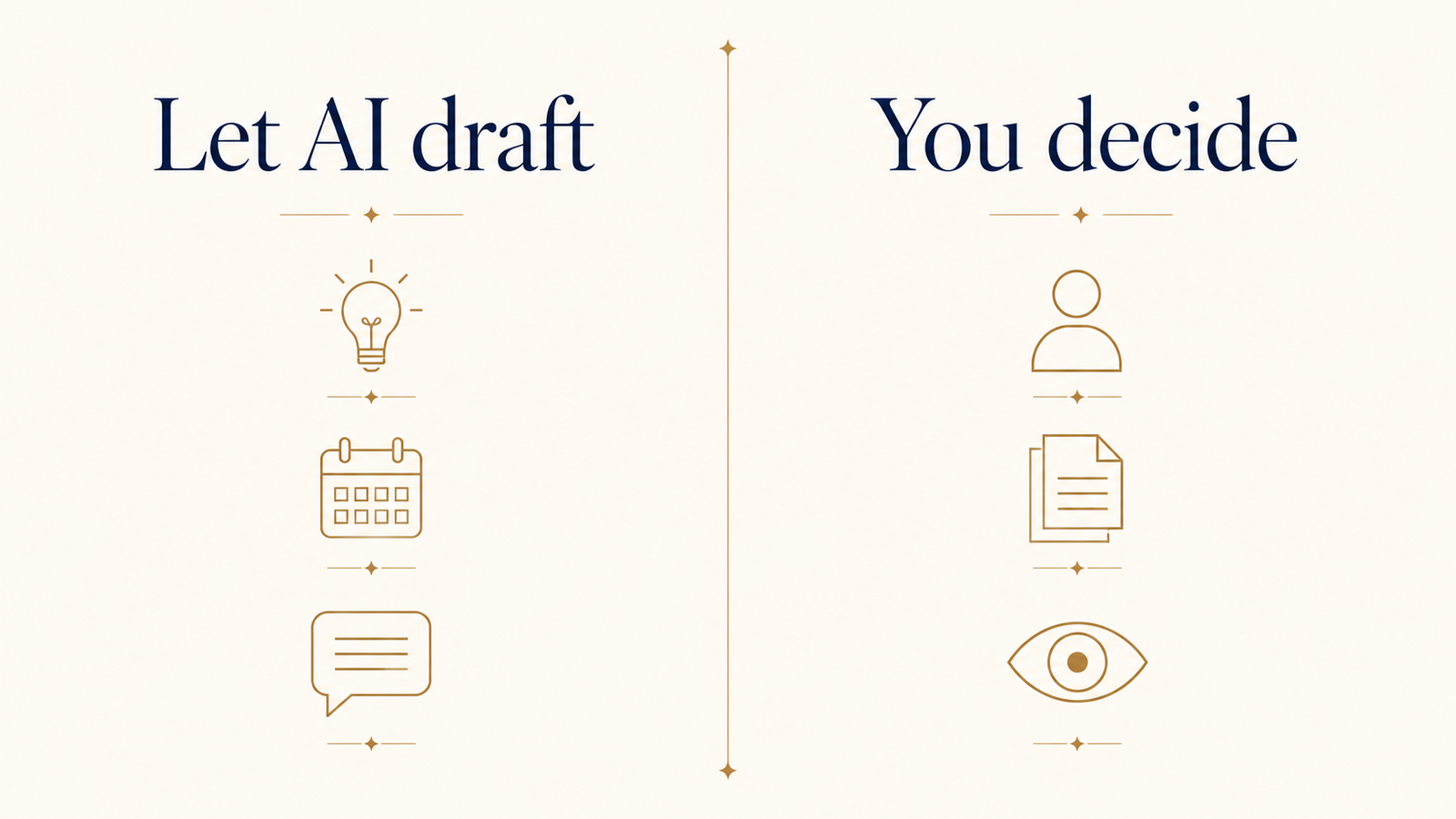
Here's the whole thing in one line: let AI draft, and you decide. Use it for the blank page, the structure, and the ten options. Keep the point of view, the story, the taste, and the final call for yourself. Done that way, AI doesn't dilute your content. It removes the busywork so you have more time for the part that was always the point.
The tools worth having are the ones built on that principle, that draft fast and then get out of your way. That's exactly how we built ours: the Brainstormer for ideas, and a small set of AI tools for hooks, captions, calendars, and product specs, all designed to hand you a strong draft you finish in your own voice.
FAQ
Will AI-written content hurt my SEO or reach?
Generic, unedited AI content can hurt you, because search engines and audiences both reward original, helpful material. AI used as a drafting assistant, with your edits, voice, and point of view on top, does not.
What should I never let AI do?
Never let AI supply your point of view, your real stories, or your final judgment on what to publish. It can draft and speed things up, but the taste and the take have to be yours.
Is it obvious when content is AI-written?
Often, yes. Unedited AI writing has a recognizable flatness and hedging. A quick pass for your own phrasing, a real example, and a clear opinion removes the tell.
Use the tools. Just don't let them use your name without your fingerprints on it.
AI tools that draft, so you can decide
Hooks, captions, content calendars, and product ideas, built to hand you a strong first draft you finish in your own voice. Start free.
Try the free Brainstormer →